This is from "The Army Times"
‘Green’ ammo shipped to Afghanistan
By Matthew Cox - Staff writer
Posted : Thursday Jun 24, 2010 13:22:23 EDT
This summer soldiers will start fighting with a new, “green” bullet that Army ballistics officials are touting as “the best general purpose 5.56mm round ever.”
The Army has begun shipping the M855A1 Enhanced Performance Round to soldiers serving in Afghanistan, according to a June 23 press release from Picatinny Arsenal, N.J.
The announcement comes 11 months after the service had to halt the program when the M855A1 lead-free slug failed to perform under high temperatures.
The new M855A1 will replace the current Cold War-era M855 round, which was developed in the 1970s and approved as an official NATO round in 1980.
In recent years, troops have widely criticized it. They complain it is ineffective against barriers such as car windshields and often travels right through unarmored insurgents, with less than lethal effects.
The M855A1 has a “number of significant enhancements not found in the current round. These include improved hard-target capability, more dependable, consistent performance at all distances, improved accuracy, reduced muzzle flash and a higher velocity,” the press release stated.
“During testing, the M855A1 performed better than current 7.62mm ball ammunition against certain types of targets, blurring the performance differences that previously separated the two rounds.”
The Army has recently completed the Limited Rate Initial Production phase for the M855A1 and is beginning the follow-on full rate production phase in which they plan to procure more than 200 millions rounds over the next 12 to 15 months.
Unlike the current round, the M855A1 is designed for use in the M4 carbine, which has a 14.5-inch barrel compared to the M16’s 20-inch barrel.
The Enhanced Performance Round contains an environmentally friendly projectile that eliminates up to 2,000 tons of lead from the manufacturing process each year in direct support of Army commitment to environmental stewardship, the release states.
“Its fielding represents the most significant advancement in general purpose small caliber ammunition in decades,” Lt. Col. Jeffrey K. Woods, the program’s product manager, said in the release
Temperature issues arise for lead-free slug
By Matthew Cox - Staff writer
Posted : Monday Aug 10, 2009 17:40:21 EDT
The Army is scrapping the latest design for its eco-friendly 5.56mm ammo after some of the bullets began to show trajectory problems when exposed to hot temperatures.
Army ballistics officials halted production of the M855A1 Lead Free Slug ammunition in mid July, launched an investigation and decided to replace the bismuth-tin alloy slug with another material, said Lt. Col. Jeff Woods, product manager for Small Caliber Ammunition.
“We are currently evaluating alternate lead-free materials, and we will resume qualification once a selection is made,” Woods told Army Times.
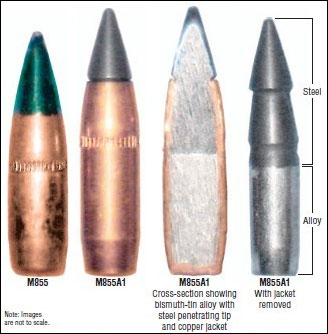
In the M855A1 LFS bullet’s design, the bismuth-tin alloy sits beneath a steel penetrating tip. A copper jacket encases all but the point of the bullet. The round was designed to work specifically with the M4 carbine. Army officials have maintained that the new round will provide more “consistent performance” than the current M855 round and perform better against hard targets.
The problem surfaced when some of the bullets did not follow their trajectory or planned flight path.
“During ballistic testing of production LFS cartridges, we noticed that some projectiles occasionally varied from the intended trajectory,” Woods said.
The plan was to start issuing the first of 20 million rounds in August, replacing the standard M855 lead round.
One thing the Army is sure of is that “this will delay fielding of the new round,” Woods said.
This is not the first hiccup to occur in the quest for lead-free ammunition, a program the Army has invested tens of millions of dollars in since the mid-1990s.
The first attempt featured a tungsten-nylon bullet that didn’t perform well and proved almost as harmful to the environment as lead.
This new wrinkle in the program appears to be linked to “higher temperatures,” but ballistic officials would not describe the specific temperature at which the problem occurs.
Sources familiar with the program said that the bismuth-tin alloy softens under heated temperatures, causing the round to perform inconsistently.
“It’s the slug; that’s where the problem is,” said Ken McKee, who works in the quality assurance department for ATK’s Small Caliber Ammunition Systems at the Lake City Army Ammunition Plant in Independence, Mo.
He also said that the timeline for the current lead-free slug design may have been too ambitious.
“We had a delivery schedule; this kind of knocked a hole in that,” McKee said. “It was a very aggressive schedule to begin with.”
A more recent article in "The Army Times", last week or the week before showed a cross-section of the new round. It did not look like the one in the original article, It showed a copper bullet with a 19 grain steel tip, with a longer length than than the original M855. Since the copper is denser than steel it should get the urge to tumble easier than the current round in a soft target, but follow the steel through a hard target such as a windshield or armor plate.
From "the Marine Corps Times"
Corps takes a new look at green bullet
By Dan Lamothe and Matthew Cox - Staff writers
Posted : Wednesday Jul 14, 2010 12:43:06 EDT
The Marine Corps intends to purchase 1.8 million rounds of the Army’s new green bullet in addition to the millions of U.S. Special Operations Command cartridges already downrange as the service looks to find the best replacement for its Cold War-era ammo.
The new environmentally friendly M855A1 Enhanced Performance Round is on the way to U.S. soldiers in Afghanistan, Army officials said, with about 1 million rounds arriving soon. The updated 5.56mm round is touted as more effective than old M855 ammunition and, in some cases, 7.62mm rounds currently in use.
The new M855A1 will be used by the Army to replace the Cold War-era M855 round, which was developed in the 1970s and approved as an official NATO round in 1980. In recent years, troops have widely criticized it, saying it is ineffective against barriers such as car windshields and often travels right through unarmored insurgents, with less-than-lethal effects.
The Army plans to buy about 200 million rounds of the new ammunition over the next 12 to 15 months, Army officials said late last month. The announcement came 11 months after the service had to halt the program when the M855A1 lead-free slug failed to perform under high temperatures.
The lead-free M855A1 is more dependable than the current M855 and delivers consistent performance at all distances, Army officials said. It performed better than the current-issue 7.62mm round against hardened steel targets in testing, penetrating æ-inch-thick steel at ranges approaching 400 meters, tripling the performance of the M855, Army officials said.
“For hardened steel, it is definitely better than the 7.62mm round,” said Chris Grassano, who runs the Army’s Project Manager Maneuver Ammunition Systems.
The Corps had planned to field the Army’s M855A1 until the program suffered a major setback in August 2009, when testing revealed that some of the bullets did not follow their trajectory or intended flight path. The bismuth-tin slug proved to be sensitive to heat, prompting Marine officials to choose the enhanced Special Operations Science and Technology round developed by U.S. Special Operations Command instead. Commonly known as SOST ammo, the bullet isn’t environmentally friendly, but it offered the Corps a better bullet after the Army’s M855A1 round failed. Marine infantrymen began using it in Afghanistan this spring.
The Army has replaced the bismuth-tin slug in its new round with a copper one, solving the bullet’s problems, Army officials said. More than 500,000 rounds have been fired in testing.
With the improvements to the lead-free round, the Corps is again considering it as a long-term replacement for the old M855 bullet, said Capt. Geraldine Carey, a spokeswoman for Marine Corps Systems Command, based at Quantico, Va. The Corps already has bought 4.5 million cartridges of SOST ammo as “interim enhanced capability,” but also will receive 1.8 million rounds of the new Army bullet in July, she said. A decision to field the new M855A1 bullet will be based on how well it does in additional testing. Either way, the Corps plans to continue replacing the older M855 round.
The SOST bullet weighs 62 grains and has a lead core with a solid copper shank. It is considered a variation of Federal Cartridge Co.’s Federal Trophy Bonded Bear Claw round, which was developed for big-game hunting and is touted in a company news release for its ability to crush bone. It uses an open-tip match round design common with sniper ammunition, provides Marines deadlier ammunition with more stopping power, and stays on target through windshields and car doors better than conventional M855 ammo.
The new Army round also weighs 62 grains and has a 19-grain steel penetrator tip, 9 grains heavier than the tip on old M855 ammo. Seated behind the penetrator is a solid copper slug.
Unlike the old M855 round, the M855A1 is designed for use in the M4 carbine, which has a 14.5-inch barrel, compared with the M16’s 20-inch barrel. The propellant has been tailored to reduce the muzzle flash of the M4, but it also works in the M16A4 and other rifles chambered for 5.56mm ammunition.
You just have to ask yourself, is he telling you the truth based on knowledge and experience or spreading internet myths?