Page 1 of 2
Army's new 5.56 M855A1 Ammo
Posted: Tue, 27 Jul 2010 15:01:34
by Unkn0wN
Not sure if anyone has heard of this yet, but the Army has a new 5.56 ammo. It is lead free and has a steel penetrating tip.
U.S. Army Issues New M855A1 Ammo to Troops in Afghanistan
The U.S. Army has begun shipping its new, improved 5.56×45 cartridge, the M855A1 Enhanced Performance Round, to U.S. troops in Afghanistan. The Army will procure over 200 million rounds of the new M855A1 ammo in the next 12-15 months, and soldiers in Afghanistan will begin using M855A1 ammo in the summer of 2010. The new round replaces the current M855 cartridge used by U.S. troops since the early 1980s.

The military sought to replace current M855 ammo because M855 has not performed adequately in the Afghan theater. Specific complaints include: 1) inability to effectively penetrate vehicle windshields; 2) poor long-range performance; and 3) failure to fragment even in short-range anti-personnel use. The Army’s Picatinny Arsenal claims that the new M855A1 has improved hard target capability, more consistent performance at all distances, improved accuracy, reduced muzzle flash, and higher velocity. M855A1 ammo is tailored for use in M4 carbines but should also give enhanced performance in M16s and M249s.
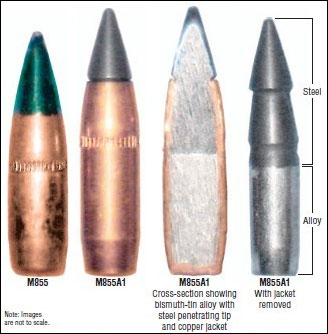 New Steel-Tip Bullet Design
The 62-grain bullet for the new M855A1 ammo is a completely new design. While it may appear to have a plastic “ballistic tip”, that’s deceiving. The new bullet created for M855A1 ammo has a bismuth-tin alloy core with a steel “stacked-cone” penetrating tip. The photo at right shows the version from last year; the final production version may be slightly different (e.g. the final version tip is a different color). Apparently the latest bullet design is a winner. During testing, M855A1 ammo
performed better than current 7.62mm ball ammunition against certain types of targets. According to Lt. Col. Jeffrey K. Woods, the program’s product manager, the new M855A1 ammo is “the best general purpose 5.56mm round ever produced. A true general purpose round, the M855A1 exceeds the performance of the current M855 against the many different types of targets likely to be encountered in combat.” The chart below illustrates how M855A1 ammo performs on hard targets compared to M855.
 Over One Million Rounds Fired in Army Tests
Prior to initial production, the new M855A1 round underwent vigorous testing. Official qualification of the round consisted of a series of side-by-side tests with the current M855. Overall, the Army fired more than one million rounds to ensure the new cartridge met all expectations. The new M855A1 round is the “most thoroughly tested small caliber round ever fielded” according to Lt. Col. Woods. The new M855A1 is sometimes called “Green Ammo” because it uses a lead-free projectile. Woods said the M855A1’s bullet design shows how “greening” a previously hazardous material can also provide extremely beneficial performance improvements.
http://bulletin.accurateshooter.com/201 ... ghanistan/
Re: Army's new 5.56 M855A1 Ammo
Posted: Tue, 27 Jul 2010 15:05:07
by allingeneral
Maybe we'll see some nice prices on the old M855 surplus!

Re: Army's new 5.56 M855A1 Ammo
Posted: Tue, 27 Jul 2010 15:51:56
by acguy45
We will hopefully one day but it's going to take awhile for them to get enough of the new ammo they are making into circulation and to get it forward to the troops down range. They didn't start issuing it until this summer. they are looking at 12-15 months to make the 200 million rnds the army is calling for, and thats without issues or delays (I'm pretty sure there will be some.)
the army will still probably be using the old M855 for duty and training for a couple more years.
Re: Army's new 5.56 M855A1 Ammo
Posted: Tue, 27 Jul 2010 16:00:43
by 06bolton5pt3
just ditch the damn 5.56. 6.8spc or something else with knockdown like we use to have back when we had garands, m14's, etc
Re: Army's new 5.56 M855A1 Ammo
Posted: Tue, 27 Jul 2010 16:05:46
by gunderwood
Yes, it is being called "brown tip." Interesting stuff. The lab testing seems to have focused on barrier penetration issues with M855. They field tested some other 5.56/7.62 rounds (similar to trophy bear claw) for a while in the same vain of thought. I'd be interested to see how it works on non-hardened targets.
Re: Army's new 5.56 M855A1 Ammo
Posted: Tue, 27 Jul 2010 21:18:04
by arkypete
The current ammo is like stabbing the enemy with a knitting needle. This new stuff will be worse, making a nice neat hole all the way thru. If the fellow who got shot is paying attention he'll know that he's been shot.
7.62 NATO gets the job done.
Jim
Re: Army's new 5.56 M855A1 Ammo
Posted: Tue, 27 Jul 2010 21:37:59
by gunderwood
arkypete wrote:The current ammo is like stabbing the enemy with a knitting needle. This new stuff will be worse, making a nice neat hole all the way thru. If the fellow who got shot is paying attention he'll know that he's been shot.
7.62 NATO gets the job done.
Jim
It depends. It took a very long time, but we finally figured out what the deal with M855 and fragmentation was. Part of the issue is that it is barrel, range, and bullet dependant. The issue is neck length. The round will yaw over and if it is going fast enough, it will fragment reliably. The issue is when it does these things. Some rounds do it quickly (2-3"), while others take a considerable distance. The neck length on some tests (backed up by field data) was so long that the 5.56mm literally exited the target before beginning its yaw. In the first case 5.56mm is a decent stopper, in the second fails miserably. They finally figured out that the variable performance of the round (neck length before yaw) was due to bullet stability and yaw angle. If there was little or no yaw angle when the bullet hit the target, it would take forever to destabilize and begin yawing. However, if the bullet had a reasonably large yaw angle the neck length would be very short and fragmentation would occur within the body.
The alloy core and steel penetrator should make the overall length longer for a given mass (grains). A longer bullet requires more twist (higher twist rate) to stabilize. Since the military isn't changing their 1:7 twist barrels, that could mean the bullet upsets quickly and tumbles. Fragmentation depends on the alloy strength. It could occur at a lower velocity or a higher one (M855 generally is 2700fps and higher).
Of course, that may not have been a design objective or perhaps they just don't want to know so it can't be a "dum-dum" bullet. These new bullets appear to be much more effective at punching through barriers. Perhaps, they determined that if even .22 cal pencil holes is better than having you bullet no penetrate the enemies cover (change cover to concealment).
Will be interesting though.
Hornady's 75gr TAP is the stuff to have for HD!
Edit: I doubt it will perform better, but it might do so more reliably. When 5.56mm fragments it is a deadly round. Of course the heavier 75/77gr rounds are much better.
Re: Army's new 5.56 M855A1 Ammo
Posted: Thu, 29 Jul 2010 17:21:48
by CowboyT
Question: how good is the "old" M855 for hunting non-humans, i. e. coyotes, feral hogs, and such? I know that feral pigs aren't that common in VA like they are in, say, TX, but I'd imagine they're still good eatin'.
Also, do people actually eat coyote or use the hide for any purposes (e. g. jackets or whatever)?
Re: Army's new 5.56 M855A1 Ammo
Posted: Thu, 29 Jul 2010 21:29:23
by gunderwood
CowboyT wrote:Question: how good is the "old" M855 for hunting non-humans, i. e. coyotes, feral hogs, and such? I know that feral pigs aren't that common in VA like they are in, say, TX, but I'd imagine they're still good eatin'.
Also, do people actually eat coyote or use the hide for any purposes (e. g. jackets or whatever)?
Not good. Those animals are too thin and the M855 bullet won't tumble/fragment before exiting (generally). Get the Hornady V-Max rounds for that, they are awesome.
Re: Army's new 5.56 M855A1 Ammo
Posted: Fri, 30 Jul 2010 08:28:23
by rromeo
CowboyT wrote:Question: how good is the "old" M855 for hunting non-humans, i. e. coyotes, feral hogs, and such? I know that feral pigs aren't that common in VA like they are in, say, TX, but I'd imagine they're still good eatin'.
Also, do people actually eat coyote or use the hide for any purposes (e. g. jackets or whatever)?

Re: Army's new 5.56 M855A1 Ammo
Posted: Fri, 30 Jul 2010 08:31:20
by acguy45
Thats an interesting piece of headgear there, I definately wouldn't wear that out in the woods though , you might end up with an extra hole in your head.
Re: Army's new 5.56 M855A1 Ammo
Posted: Fri, 30 Jul 2010 09:36:42
by gunderwood
I've never heard of anyone eating them...scavengers generally aren't good eats. Some people do use FMJ and such to preserve the pelt. I've never got me a coyote, so that is just stuff I've picked up in passing.
Re: Army's new 5.56 M855A1 Ammo
Posted: Sat, 31 Jul 2010 15:14:48
by zephyp
Lead free even...wow. I bet that got a few hand claps. Regarding penetration, I'm all for it...all the way through. Let it tumble a couple of times to rip things up a bit (or not) and come on out the other side. Two holes equals 1 hole x 2. Thats twice the blood loss in the same amount of time...

Re: Army's new 5.56 M855A1 Ammo
Posted: Sat, 31 Jul 2010 23:54:38
by meadmkr
CowboyT wrote:Also, do people actually eat coyote or use the hide for any purposes (e. g. jackets or whatever)?
Never known anybody to eat one (on purpose) but years ago when I was stationed in the Peoples Republic of Kalifornia a lot of hunters took pelts collected during the winter for making faux, er, fur coats. Clipped and dyed it make a pretty nice looking jacket or lining for a parka hood.
Cheers
CW
Re: Army's new 5.56 M855A1 Ammo
Posted: Sun, 01 Aug 2010 16:56:29
by grumpyMSG
This is from "The Army Times"
‘Green’ ammo shipped to Afghanistan
By Matthew Cox - Staff writer
Posted : Thursday Jun 24, 2010 13:22:23 EDT
This summer soldiers will start fighting with a new, “green” bullet that Army ballistics officials are touting as “the best general purpose 5.56mm round ever.”
The Army has begun shipping the M855A1 Enhanced Performance Round to soldiers serving in Afghanistan, according to a June 23 press release from Picatinny Arsenal, N.J.
The announcement comes 11 months after the service had to halt the program when the M855A1 lead-free slug failed to perform under high temperatures.
The new M855A1 will replace the current Cold War-era M855 round, which was developed in the 1970s and approved as an official NATO round in 1980.
In recent years, troops have widely criticized it. They complain it is ineffective against barriers such as car windshields and often travels right through unarmored insurgents, with less than lethal effects.
The M855A1 has a “number of significant enhancements not found in the current round. These include improved hard-target capability, more dependable, consistent performance at all distances, improved accuracy, reduced muzzle flash and a higher velocity,” the press release stated.
“During testing, the M855A1 performed better than current 7.62mm ball ammunition against certain types of targets, blurring the performance differences that previously separated the two rounds.”
The Army has recently completed the Limited Rate Initial Production phase for the M855A1 and is beginning the follow-on full rate production phase in which they plan to procure more than 200 millions rounds over the next 12 to 15 months.
Unlike the current round, the M855A1 is designed for use in the M4 carbine, which has a 14.5-inch barrel compared to the M16’s 20-inch barrel.
The Enhanced Performance Round contains an environmentally friendly projectile that eliminates up to 2,000 tons of lead from the manufacturing process each year in direct support of Army commitment to environmental stewardship, the release states.
“Its fielding represents the most significant advancement in general purpose small caliber ammunition in decades,” Lt. Col. Jeffrey K. Woods, the program’s product manager, said in the release
Temperature issues arise for lead-free slug
By Matthew Cox - Staff writer
Posted : Monday Aug 10, 2009 17:40:21 EDT
The Army is scrapping the latest design for its eco-friendly 5.56mm ammo after some of the bullets began to show trajectory problems when exposed to hot temperatures.
Army ballistics officials halted production of the M855A1 Lead Free Slug ammunition in mid July, launched an investigation and decided to replace the bismuth-tin alloy slug with another material, said Lt. Col. Jeff Woods, product manager for Small Caliber Ammunition.
“We are currently evaluating alternate lead-free materials, and we will resume qualification once a selection is made,” Woods told Army Times.
In the M855A1 LFS bullet’s design, the bismuth-tin alloy sits beneath a steel penetrating tip. A copper jacket encases all but the point of the bullet. The round was designed to work specifically with the M4 carbine. Army officials have maintained that the new round will provide more “consistent performance” than the current M855 round and perform better against hard targets.
The problem surfaced when some of the bullets did not follow their trajectory or planned flight path.
“During ballistic testing of production LFS cartridges, we noticed that some projectiles occasionally varied from the intended trajectory,” Woods said.
The plan was to start issuing the first of 20 million rounds in August, replacing the standard M855 lead round.
One thing the Army is sure of is that “this will delay fielding of the new round,” Woods said.
This is not the first hiccup to occur in the quest for lead-free ammunition, a program the Army has invested tens of millions of dollars in since the mid-1990s.
The first attempt featured a tungsten-nylon bullet that didn’t perform well and proved almost as harmful to the environment as lead.
This new wrinkle in the program appears to be linked to “higher temperatures,” but ballistic officials would not describe the specific temperature at which the problem occurs.
Sources familiar with the program said that the bismuth-tin alloy softens under heated temperatures, causing the round to perform inconsistently.
“It’s the slug; that’s where the problem is,” said Ken McKee, who works in the quality assurance department for ATK’s Small Caliber Ammunition Systems at the Lake City Army Ammunition Plant in Independence, Mo.
He also said that the timeline for the current lead-free slug design may have been too ambitious.
“We had a delivery schedule; this kind of knocked a hole in that,” McKee said. “It was a very aggressive schedule to begin with.”
A more recent article in "The Army Times", last week or the week before showed a cross-section of the new round. It did not look like the one in the original article, It showed a copper bullet with a 19 grain steel tip, with a longer length than than the original M855. Since the copper is denser than steel it should get the urge to tumble easier than the current round in a soft target, but follow the steel through a hard target such as a windshield or armor plate.
From "the Marine Corps Times"
Corps takes a new look at green bullet
By Dan Lamothe and Matthew Cox - Staff writers
Posted : Wednesday Jul 14, 2010 12:43:06 EDT
The Marine Corps intends to purchase 1.8 million rounds of the Army’s new green bullet in addition to the millions of U.S. Special Operations Command cartridges already downrange as the service looks to find the best replacement for its Cold War-era ammo.
The new environmentally friendly M855A1 Enhanced Performance Round is on the way to U.S. soldiers in Afghanistan, Army officials said, with about 1 million rounds arriving soon. The updated 5.56mm round is touted as more effective than old M855 ammunition and, in some cases, 7.62mm rounds currently in use.
The new M855A1 will be used by the Army to replace the Cold War-era M855 round, which was developed in the 1970s and approved as an official NATO round in 1980. In recent years, troops have widely criticized it, saying it is ineffective against barriers such as car windshields and often travels right through unarmored insurgents, with less-than-lethal effects.
The Army plans to buy about 200 million rounds of the new ammunition over the next 12 to 15 months, Army officials said late last month. The announcement came 11 months after the service had to halt the program when the M855A1 lead-free slug failed to perform under high temperatures.
The lead-free M855A1 is more dependable than the current M855 and delivers consistent performance at all distances, Army officials said. It performed better than the current-issue 7.62mm round against hardened steel targets in testing, penetrating æ-inch-thick steel at ranges approaching 400 meters, tripling the performance of the M855, Army officials said.
“For hardened steel, it is definitely better than the 7.62mm round,” said Chris Grassano, who runs the Army’s Project Manager Maneuver Ammunition Systems.
The Corps had planned to field the Army’s M855A1 until the program suffered a major setback in August 2009, when testing revealed that some of the bullets did not follow their trajectory or intended flight path. The bismuth-tin slug proved to be sensitive to heat, prompting Marine officials to choose the enhanced Special Operations Science and Technology round developed by U.S. Special Operations Command instead. Commonly known as SOST ammo, the bullet isn’t environmentally friendly, but it offered the Corps a better bullet after the Army’s M855A1 round failed. Marine infantrymen began using it in Afghanistan this spring.
The Army has replaced the bismuth-tin slug in its new round with a copper one, solving the bullet’s problems, Army officials said. More than 500,000 rounds have been fired in testing.
With the improvements to the lead-free round, the Corps is again considering it as a long-term replacement for the old M855 bullet, said Capt. Geraldine Carey, a spokeswoman for Marine Corps Systems Command, based at Quantico, Va. The Corps already has bought 4.5 million cartridges of SOST ammo as “interim enhanced capability,” but also will receive 1.8 million rounds of the new Army bullet in July, she said. A decision to field the new M855A1 bullet will be based on how well it does in additional testing. Either way, the Corps plans to continue replacing the older M855 round.
The SOST bullet weighs 62 grains and has a lead core with a solid copper shank. It is considered a variation of Federal Cartridge Co.’s Federal Trophy Bonded Bear Claw round, which was developed for big-game hunting and is touted in a company news release for its ability to crush bone. It uses an open-tip match round design common with sniper ammunition, provides Marines deadlier ammunition with more stopping power, and stays on target through windshields and car doors better than conventional M855 ammo.
The new Army round also weighs 62 grains and has a 19-grain steel penetrator tip, 9 grains heavier than the tip on old M855 ammo. Seated behind the penetrator is a solid copper slug.
Unlike the old M855 round, the M855A1 is designed for use in the M4 carbine, which has a 14.5-inch barrel, compared with the M16’s 20-inch barrel. The propellant has been tailored to reduce the muzzle flash of the M4, but it also works in the M16A4 and other rifles chambered for 5.56mm ammunition.
Re: Army's new 5.56 M855A1 Ammo
Posted: Tue, 03 Aug 2010 21:36:16
by CowboyT
For combat against armored targets, this sounds like really good ammo. But for hunting (my eventual intended use, haven't done it yet), it sounds like the "old" M855, kinda useless, based on the feedback here and the reading. Will examine those Hornady V-Max's for that purpose. Thanks for that tip.
Re: Army's new 5.56 M855A1 Ammo
Posted: Thu, 05 Aug 2010 04:41:58
by zephyp
CowboyT wrote:For combat against armored targets, this sounds like really good ammo. But for hunting (my eventual intended use, haven't done it yet), it sounds like the "old" M855, kinda useless, based on the feedback here and the reading. Will examine those Hornady V-Max's for that purpose. Thanks for that tip.
Yep but the nice thing about the old rounds (hopefully the new ones too) was when they hit something hard like bone they had a tendency to take a new direction and keep going till they were depleted of energy or mass. So, you could get shot in the upper front shoulder and have it come out your lower back. Two holes and internal damage along the way plus a nice little shock channel. The 5.56 round's ability to do this is overshadowed by the 7.62x39 which from some perspectives make it a better combat round...and of course the old argument of which is better - AR or AK comes back up...

Re: Army's new 5.56 M855A1 Ammo
Posted: Thu, 05 Aug 2010 06:36:47
by gunderwood
zephyp wrote:CowboyT wrote:For combat against armored targets, this sounds like really good ammo. But for hunting (my eventual intended use, haven't done it yet), it sounds like the "old" M855, kinda useless, based on the feedback here and the reading. Will examine those Hornady V-Max's for that purpose. Thanks for that tip.
Yep but the nice thing about the old rounds (hopefully the new ones too) was when they hit something hard like bone they had a tendency to take a new direction and keep going till they were depleted of energy or mass. So, you could get shot in the upper front shoulder and have it come out your lower back. Two holes and internal damage along the way plus a nice little shock channel. The 5.56 round's ability to do this is overshadowed by the 7.62x39 which from some perspectives make it a better combat round...and of course the old argument of which is better - AR or AK comes back up...
Lies I tell you!
The whole shootem in the butt it comes out their face is Vietnam war nonsense. It is easy to show that the forces on a bullet to turn that sharply (for 5.56mm) would be sufficient to cause it to break apart. The bullet does deviate from its flight path after striking a solid object like a car door or windshield, but these rounds were designed to minimize that. They also deviate in soft targets, but the amount of deviation is a much smaller than the stories would have you believe.
The 7.62x39 isn't better than the 5.56mm with the proper ammo. The Russian round also wants to flip around, but does so way to late to be of any value. Generally it is travelling to slow after even a short distance to cause cavitation. The one benefit it has going for it is .30cal. It does create a larger hole, but it really is FMJ. Sure you can get SP/HP, but those may not work well in traditional semiauto AKs which is the direct comparison here.
If the 5.56mm fragments, it is vastly superior to the 7.62x39. The problem was inconstant fragmentation. That can be easily addressed by shooting Hornady's 75gr TAP. Still FMJ, but it fragments reliably and at lower velocities than military ammo. It does much more damage too. The problem is when 5.56mm doesn't fragment. It has a habit of punching a .22cal hole and not much else.
Don't forget that many of the 5.56mm "failures" come from war zones where the enemy is shooting back. The it took 3 mags to kill one dude is mostly misses. LE in the US using the 5.56mm and won't even touch the 7.62x39.
Take your commie ways and ammo elsewhere...


Re: Army's new 5.56 M855A1 Ammo
Posted: Fri, 06 Aug 2010 06:40:28
by zephyp
gunderwood wrote:
Lies I tell you!

Re: Army's new 5.56 M855A1 Ammo
Posted: Fri, 06 Aug 2010 08:24:32
by gunderwood
zephyp wrote:gunderwood wrote:
Lies I tell you!
Twas just messing with you.
