Page 1 of 2
Tactical Nukes Used in Yemen
Posted: Wed, 03 Jun 2015 18:57:39
by Greybeard
SAUDIS have ISRAEL "NUKE" Yeman for them! VIDEO Proof as IAEA confirms "probable" Israeli Nuclear Attack on Yemen, May 20, 2015
- A. The range of the camera is calculated to be about 4 to 5 miles from ground zero based on shock wave.
Delivery is most likely by an IDF F-16 with a Saudi paint job on the plane. They are not even hiding their use anymore, they just don’t publicly admit it and the IAEA does nothing or says nothing. That is the true war crime. The UN just ignores it unless the US, France or GB complains…….. Russia and China say nothing.
This is now the second known use of nukes in Yemen by Saudi Arabia … May 12 and 20.
More here:
http://www.veteranstoday.com/2015/05/21/358343/
Re: Tactical Nukes Used in Yemen
Posted: Wed, 03 Jun 2015 19:20:28
by FiremanBob
Re: Tactical Nukes Used in Yemen
Posted: Wed, 03 Jun 2015 23:55:11
by Ron71
Why do they think it's a nuke without radiation numbers? Just because it has a mushroom cloud and made a large "boom"? What is the basis of the "analysis"?!?!
Re: Tactical Nukes Used in Yemen
Posted: Thu, 04 Jun 2015 00:48:13
by MarcSpaz
I'm not an expert, but that looks way too small of an explosion for a conventional neutron bomb. Also, a neutron bomb expels 10x more radiation then a conventional fusion bomb in the form of a neutron wave that visibly radiates out from ground-zero. I didn't see any neutron wave at all. That explosion looks about 1.5 to 2 miles away. The shock wave from a nuke heat blast would have killed the guy holding the camera in seconds. And if the heat blast didn't, the neutron wave (which clearly doesn't exist in that video) would have killed him withing seconds at that range.
As far as the mushroom cloud goes, I used to try to impress girls when I was a kid making mushroom blasts buy pumping butane into my fist and then lighting it on fire as I opened my hand. Any blast that rapidly heats the air could cause the appearance of a mushroom cloud as the super heated air rises about the cooler air rushing in underneath it.
I give this story

Re: Tactical Nukes Used in Yemen
Posted: Thu, 04 Jun 2015 11:42:56
by Jeff82
Nukes? Verified by who?
Re: Tactical Nukes Used in Yemen
Posted: Thu, 04 Jun 2015 13:21:31
by Ironbear
MarcSpaz wrote:Also, a neutron bomb expels 10x more radiation then a conventional fusion bomb in the form of a neutron wave that visibly radiates out from ground-zero. I didn't see any neutron wave at all.
Hmmm. Do have any references that support that you can "see" neutron waves?
I agree that this is tinfoil hat territory. GPS satellites have nuclear explosion detectors, and it is probably reasonable to assume that the Russian GLONASS and European Galileo satellites do too, and probably the Chinese and Indian regional systems. I am willing to bet that virtually every country able to put satellites up, has something designed to detect nuclear explosions. In addition, the Comprehensive Test Ban Treaty Organization also has a world-wide monitoring system, some 85-90% complete, explicitly meant to detect nuclear explosions.
There is so little love lost, between governments, official organizations, etc.; that if a nuke was set off, and there was any
real proof of it, some official somewhere would be spouting off about it; and media would be coming unglued. The idea that you could keep the detonation of a "real" nuke in the Middle East, quiet is delusional!
Re: Tactical Nukes Used in Yemen
Posted: Thu, 04 Jun 2015 18:59:55
by MarcSpaz
Ironbear wrote:MarcSpaz wrote:Also, a neutron bomb expels 10x more radiation then a conventional fusion bomb in the form of a neutron wave that visibly radiates out from ground-zero. I didn't see any neutron wave at all.
Hmmm. Do have any references that support that you can "see" neutron waves?
Yes... every video of every fusion bomb detonation over land or water... ever. You may not see the neutrons emitted from the bomb itself, but you will see the molecules of dust and debris ride the energy wave as the neutron wave moves. The blast even distorts the light because of the way it impacts the atmosphere.
Most people confuse the neutron blast wave is a rush of air moving outward from ground zero. The natural airflow actually moves up, with the heat bubble.
Re: Tactical Nukes Used in Yemen
Posted: Fri, 05 Jun 2015 14:16:00
by Ironbear
MarcSpaz wrote:Yes... every video of every fusion bomb detonation over land or water... ever. You may not see the neutrons emitted from the bomb itself, but you will see the molecules of dust and debris ride the energy wave as the neutron wave moves. The blast even distorts the light because of the way it impacts the atmosphere.
Most people confuse the neutron blast wave is a rush of air moving outward from ground zero. The natural airflow actually moves up, with the heat bubble.
The moving wave that you are talking about, is the blast over-pressure wave, not a neutron wave. It is a shock wave of compressed air, traveling at the speed of sound; and is present with nukes, conventional bombs, and even artillery (see about 0:27
here for an example, or pictures of Iowa class battleships letting loose broadsides). Physically, it is a rather extreme sonic boom!
Most of the sources I found, say that the neutron bomb neutrons are running about 14MeV (Mega electron Volt) which is a kinetic energy measure. This converts out to about 52,000 miles per second, or ~1/6 the speed of light. Since they are subatomic particles without a charge, they don't generally interact with matter and go right through it. They eventually run into some atom's nucleus, at which point all that kinetic energy gets converted into ionizing radiation, which is the part that actually kills people.
The neutron particles are too small and fast to see, and don't interact physically with matter in a way that would "drag" dust and debris along with. The main indication of their passing is a lot of gamma and x-ray emission. The following (much slower) overpressure blast wave, is highly visible, and does the typical damage that bombs do...
Re: Tactical Nukes Used in Yemen
Posted: Fri, 05 Jun 2015 15:02:17
by MarcSpaz
Like I said... I'm not an expert.
[ Post made via Mobile Device ] 
Re: Tactical Nukes Used in Yemen
Posted: Fri, 05 Jun 2015 17:36:27
by Ron71
And like I said, without actual radiation measurements it's all just a bunch of hooey.
Re: Tactical Nukes Used in Yemen
Posted: Fri, 05 Jun 2015 20:26:26
by AlanM
Neutrons are slowed down by collisions with nuclei.
More so the lighter the nucleus is, therefore water, with two hydrogen atoms is an excellent "moderator" to slow down fast neutrons (those produced by fusion or fission).
This is why water is such a good shield for fast neutrons as is polyethylene, which consists of mostly hydrogen and carbon atoms, specifically borated polyethylene (contains a large amount of boron mixed in it). The boron has a high cross section for absorption for thermal neutrons. Thermal neutrons are those that have been slowed down to the kinetic energy level of the temperature of the surrounding atoms. This energy is on the order of ~ .025 electron volts.
Each collision of a neutron with a hydrogen nucleus will cause a loss of about 50% of its energy but will cause the nucleus to leave at high velocity. Therefore for a neutron of 14 Mev to get to .025 ev will take about 30 collisions. That means there is a LOT of secondary high energy proton radiation and since protons are charged particles they cause considerable damage to living tissue.
Once the neutron has been "thermalized" it will be absorbed by a receptive nucleus which will cause that nucleus to become a higher mass nuclide which may or may not be radioactive. This adds to amount of secondary radiation of the initial explosion.
Re: Tactical Nukes Used in Yemen
Posted: Tue, 09 Jun 2015 12:34:24
by Ironbear
Being an engineer, and not a physicist... I've never understood why a light nucleus is better at moderation than a heavy one. I would have expected denser materials to work better, but this is not the case.
Re: Tactical Nukes Used in Yemen
Posted: Tue, 09 Jun 2015 18:42:17
by Reverenddel
Ya'll realize that this effin' conversation just put us all on the turr'ist watch list?
TTTTHHHAAAANNNNNKKKSSSS! HAHAHAH

Re: Tactical Nukes Used in Yemen
Posted: Wed, 10 Jun 2015 03:54:50
by MarcSpaz
Its okay... I know a guy. I'll get it squared away.

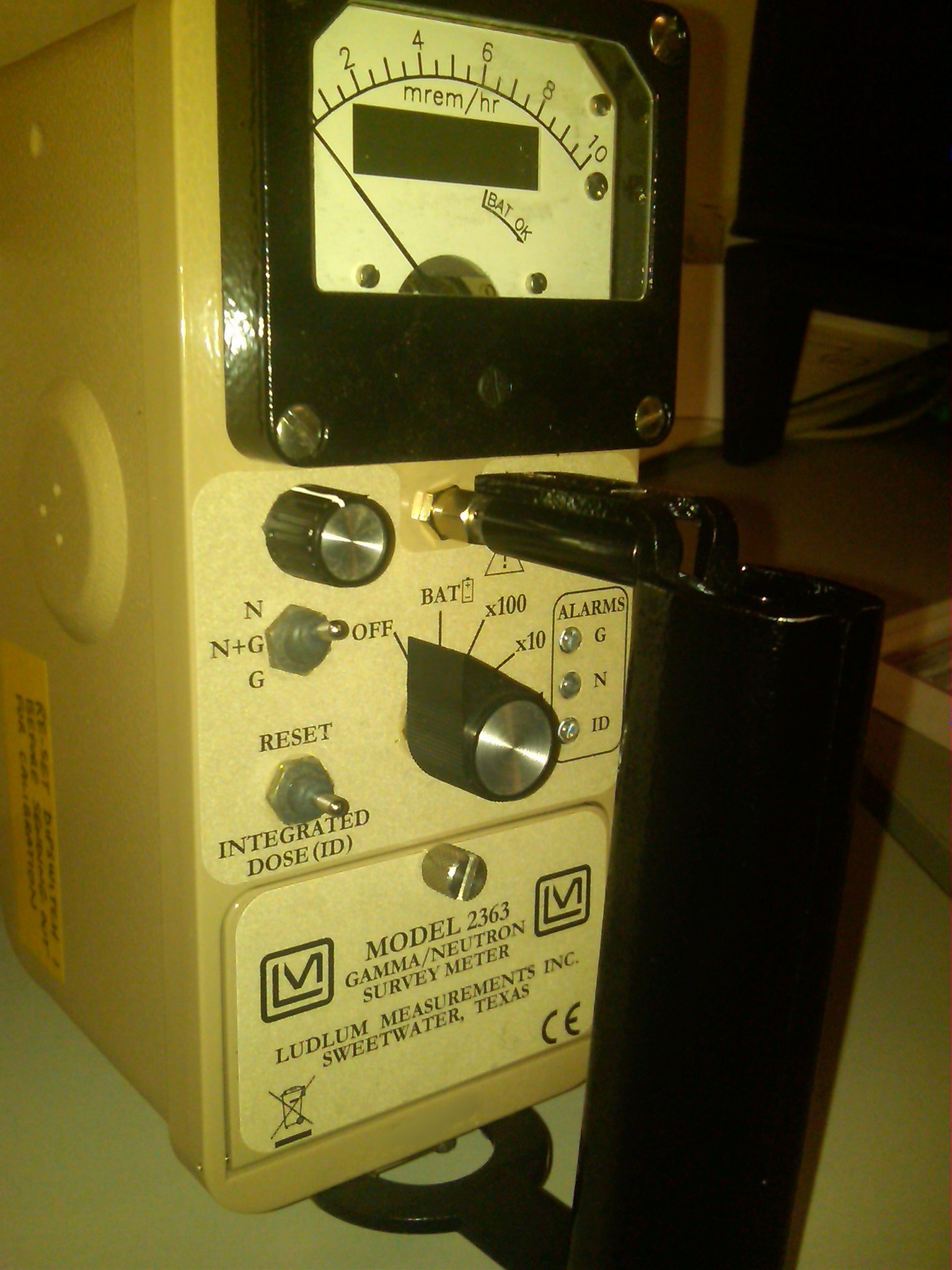
BTW... this is on of the toys I get to play with at work. The guys think I'm joking when I ask for "test material" to make sure it works. LOL
Re: Tactical Nukes Used in Yemen
Posted: Wed, 10 Jun 2015 06:54:10
by SHMIV
Is that what you use to calibrate the flux capacitor in your Delorean?
[ Post made via Mobile Device ]
Re: Tactical Nukes Used in Yemen
Posted: Wed, 10 Jun 2015 07:42:03
by AlanM
Ironbear wrote:Being an engineer, and not a physicist... I've never understood why a light nucleus is better at moderation than a heavy one. I would have expected denser materials to work better, but this is not the case.
Simple physics: It has to do with energy transfer during an elastic collision between two objects.
See:
http://en.wikipedia.org/wiki/Elastic_collision
Maximum energy transfer occurs when the masses involved are equal or nearly so.
Therefore, for a high energy neutron to lose that energy quickly it's more efficient for it to collide with particles of nearly the same mass.
The nucleus of a hydrogen atom consists of one proton which is one electron mass (approximately) less than the mass of a neutron.
When a 14 Mev neutron strikes a nearly stationary proton they both leave the event with kinetic energy totaling 14 MEv split approximately 50-50%.
(The split actually graphs as a bell curve peaking at 50%)
A 7 Mev proton is VERY dangerous since it is a charged particle and can and will react with every atom in range of it's electric field.
It's these high energy protons and their now orphaned electrons that produce the biological damage in living tissue.
Granted high energy neutrons DO get absorbed by heavier nuclei but as I said earlier this is absorption not a collision and different things happen.
Usually the effected nucleus will immediately react by emitting some sort of radiation or will fission.
Very few nuclei have a large cross section for absorption for fast neutrons.
RE: My mention of "cross section" see:
http://en.wikipedia.org/wiki/Nuclear_cross_section and
http://en.wikipedia.org/wiki/Neutron_cross_section
I hope you realize that this is stuff that was poured into my head while in Us Navy Enlisted Nuclear Power School about 48 years ago. (1967)
In those links above you will find the definition of a "barn" which is defined as a unit of area equal to 10^−28 m² or 10^−24 cm².
So in physics circles if you can hit a barn at 100 yards you are a damn good shot.
Re: Tactical Nukes Used in Yemen
Posted: Wed, 10 Jun 2015 11:08:24
by grumpyMSG
If I recall the "Neutron Bomb" discussions of the '80s during the Reagan administration. It was all theoretical, the US never actually tried to build one but only talked about it. It was supposed to have a high casualty rate due to radiation which had a short half life and did a lot less damage than a similar sized conventional nuclear warhead. In short, in theory it was supposed to kill the Army/people and leave most of the area undamaged and habitable after a few weeks.
Re: Tactical Nukes Used in Yemen
Posted: Wed, 10 Jun 2015 12:04:47
by MarcSpaz
Alan, DNDO falls under the DHS unmbrella. While doing IT related stuff for them, I have sat in the room with some of the brain's in the field of nuclear energy and listen too them talk. My ADHD will not allow me to absorb much of it. You must have really enjoyed working in the field to have remembered that info.
Did you stay in energy after you got out?
SHMIV wrote:Is that what you use to calibrate the flux capacitor in your Delorean?
[ Post made via Mobile Device ]
Don't be silly. Everyone knows Deloreans aren't real.
I actually took a picture of that detector because it was the first one I ever saw in person. I thought it was pretty cool. Funny how it looks like old tech even though it was brand new and in our lab for calibration and testing.
grumpyMSG wrote:If I recall the "Neutron Bomb" discussions of the '80s during the Reagan administration. It was all theoretical, the US never actually tried to build one but only talked about it. It was supposed to have a high casualty rate due to radiation which had a short half life and did a lot less damage than a similar sized conventional nuclear warhead. In short, in theory it was supposed to kill the Army/people and leave most of the area undamaged and habitable after a few weeks.
I think the first neutron bomb was tested in the early 60's. Anything the Reagan camp may have been talking about may have related to the whole "cold fusion" distraction... Give your enemy a ghost to chase while the gullible people of our country feel better about us nuking Russia. Thankfully, that never went down.
Re: Tactical Nukes Used in Yemen
Posted: Wed, 10 Jun 2015 16:13:08
by FiremanBob
The neutron bomb was discussed publicly in the 1970s. I remember Jimmah Cahtuh saying he would not allow it to be produced. Even back then he was probably in the pocket of the jihadis and the Russians.
Re: Tactical Nukes Used in Yemen
Posted: Wed, 10 Jun 2015 21:12:30
by Palladin
I like that Pointer Sisters' song.
